 ... and the bartender says "Hey gator! What's with all the guns!?!"
Ok, sorry, not a great joke. Seriously though, look at this lineup of models I'm working on. I hadn't noticed it until this morning. I heard on Boosted Damage about how there was an increase in bust size for the Legion ladies, but Tarin here really takes the cake. In any case, it's more painting progress.
... and the bartender says "Hey gator! What's with all the guns!?!"
Ok, sorry, not a great joke. Seriously though, look at this lineup of models I'm working on. I hadn't noticed it until this morning. I heard on Boosted Damage about how there was an increase in bust size for the Legion ladies, but Tarin here really takes the cake. In any case, it's more painting progress.
Friday, December 30, 2011
From the Desk: An alligator, a Sorceress, and a Gun Mage walk into a bar...
... and the bartender says "Hey gator! What's with all the guns!?!"
Ok, sorry, not a great joke. Seriously though, look at this lineup of models I'm working on. I hadn't noticed it until this morning. I heard on Boosted Damage about how there was an increase in bust size for the Legion ladies, but Tarin here really takes the cake. In any case, it's more painting progress.
Thursday, December 29, 2011
From the Desk: Yay for Vacation!
 I'm actually painting again, and not just a little. I'm getting a good 2 hours of painting in each day lately. It helps that I'm on vacation. I'm pretty focused on eVayl right now since it's my only unpainted Legion model, but also because it's a really sweet model. So far I'm enjoying painting this model since everything is fairly accessible. There's some awkward places to reach though, like her left cheek and the joins between her cape and back. However so far things are going smoothly. Not picture here is further progress on the Bull Snapper, and I started Tarin last night as well.
I found a little extra motivation recently when I put in my model collection into iBodger and noted what was painted and what wasn't. Even though I update my blog with that information, the iBodger representation gave me a different perspective by showing percentages:
I'm actually painting again, and not just a little. I'm getting a good 2 hours of painting in each day lately. It helps that I'm on vacation. I'm pretty focused on eVayl right now since it's my only unpainted Legion model, but also because it's a really sweet model. So far I'm enjoying painting this model since everything is fairly accessible. There's some awkward places to reach though, like her left cheek and the joins between her cape and back. However so far things are going smoothly. Not picture here is further progress on the Bull Snapper, and I started Tarin last night as well.
I found a little extra motivation recently when I put in my model collection into iBodger and noted what was painted and what wasn't. Even though I update my blog with that information, the iBodger representation gave me a different perspective by showing percentages:
- Legion - 99.0% painted
- Protectorate - 98.0% painted
- Mercenaries - 97.4% painted
- Cryx - 95.6% painted
- Cygnar - 87.5% painted
- Minions - 30.8% painted
Tuesday, December 27, 2011
From the Desk: Legion Metals
My buddy Lance suggested that I should do a blog post about how I painted the metals on Belphagore, so here it goes. This process is pretty straightforward, but somewhat lengthy. I'm not going to show any in-progress shots obviously since Belphagore is already done. First, let's look at the finished product...
 I like to have a good pop to my metals overall, but I'm not a huge fan of non-metallic metals (NMM). So to accomplish a good amount of distinction between metal surfaces, I have to somewhat force and exaggerate the look of the metal plates. My end goal is to have metal that is shaded to represent a normal zenithal highlighting look, but still preserve enough metallic appearance so that it doesn't look overly forced. For this model I also wanted to introduce a little bluish tint to the recesses just to create a little more style. It gives the metal enough variation and interest to the eye.
Ok, so that's the end goal. Now to talk about the process. For the benefit of those who haven't read my older posts about philosophies on metallics, I'm going to go into some detail here on my reasoning. This reasoning has evolved over time and I am sure it will continue to evolve yet further. So here's the process I went through as I remember it for this model:
I like to have a good pop to my metals overall, but I'm not a huge fan of non-metallic metals (NMM). So to accomplish a good amount of distinction between metal surfaces, I have to somewhat force and exaggerate the look of the metal plates. My end goal is to have metal that is shaded to represent a normal zenithal highlighting look, but still preserve enough metallic appearance so that it doesn't look overly forced. For this model I also wanted to introduce a little bluish tint to the recesses just to create a little more style. It gives the metal enough variation and interest to the eye.
Ok, so that's the end goal. Now to talk about the process. For the benefit of those who haven't read my older posts about philosophies on metallics, I'm going to go into some detail here on my reasoning. This reasoning has evolved over time and I am sure it will continue to evolve yet further. So here's the process I went through as I remember it for this model:
 I like to have a good pop to my metals overall, but I'm not a huge fan of non-metallic metals (NMM). So to accomplish a good amount of distinction between metal surfaces, I have to somewhat force and exaggerate the look of the metal plates. My end goal is to have metal that is shaded to represent a normal zenithal highlighting look, but still preserve enough metallic appearance so that it doesn't look overly forced. For this model I also wanted to introduce a little bluish tint to the recesses just to create a little more style. It gives the metal enough variation and interest to the eye.
Ok, so that's the end goal. Now to talk about the process. For the benefit of those who haven't read my older posts about philosophies on metallics, I'm going to go into some detail here on my reasoning. This reasoning has evolved over time and I am sure it will continue to evolve yet further. So here's the process I went through as I remember it for this model:
I like to have a good pop to my metals overall, but I'm not a huge fan of non-metallic metals (NMM). So to accomplish a good amount of distinction between metal surfaces, I have to somewhat force and exaggerate the look of the metal plates. My end goal is to have metal that is shaded to represent a normal zenithal highlighting look, but still preserve enough metallic appearance so that it doesn't look overly forced. For this model I also wanted to introduce a little bluish tint to the recesses just to create a little more style. It gives the metal enough variation and interest to the eye.
Ok, so that's the end goal. Now to talk about the process. For the benefit of those who haven't read my older posts about philosophies on metallics, I'm going to go into some detail here on my reasoning. This reasoning has evolved over time and I am sure it will continue to evolve yet further. So here's the process I went through as I remember it for this model:
- Basecoat black - I always basecoat my metallic surfaces black first, especially if I primed white. I just find that it helps the metallics to reflect a little better.
- Basecoat GW Boltgun Metal - GW makes some of the best metallics out there for my personal style. I start with this darker metallic tone as the basecoat. This is a pretty sketchy basecoat too. A few missed or thin spots helps with the look of the armor I feel.
- Wash GW Badab Black - I'm so addicted to this stuff. I use it all the time for metallics. It just helps get those recesses dulled back down and create good separation. This wash doesn't need to be even. It just needs to hit recesses real good. Nothing blows the look of metallics like deep corners that are reflecting light.
- Heavy wash GW Asurmen Blue - This is just applied to the recessed sections. This technique works well for Circle armor as well, except using the green wash over bronzes. As I recall, I did at least 2 coats of this wash.
- Re-basecoat GW Boltgun Metal - Now I go back and use thinned Boltgun to "re-basecoat" the raised portions of the plates. I use a thinner version of this to keep it from getting too bright. Again, I'm attempting to force some shading here and reinforce the zenithal highlight effect by not lightening up the surfaces that are pointed more downwards.
- 2BB VMC Black - Now I do some very deep forced shading by two brush blending in some slightly thinned black into recesses and on lower plates that should be darker.
- Highlight GW Boltgun Metal - Now I start working highlights back up. Nothing revolutionary here, just hitting the higher angled plates that would get more light from above.
- Highlight GW Mithril Silver - Same as the previous step, just less area being highlighted.
- Highlight VMC Metallic Medium - Again, just like previous step. Note that the metallic medium is crazy bright and has no black pigment in it at all. I try to reserve this for specific points.
Monday, December 26, 2011
From the Desk: Albino Gators (part 2)
 Merry Christmas to me! "Santa" brought me gators just like I suspected. The PP bundle was a pretty sweet gift since the only duplicates to what I already had were the Bull Snapper (for which 2 isn't a problem), and the Totem Hunter (which I may opt to paint a new one of anyway since I screwed up the base on the previous one). In addition to the bundle my buddies Henry and Lance got me the other 2 gator warlocks (Calaban and Maelok) which gives me the full spread. So I've gone from just a few unpainted items to a whole new faction. Yikes! Fortunately the Gators don't amount to a huge model count. A grand total of 15 models at this point.
 I still have a number of decisions to make in terms of creating a cohesive looking force, which is my commitment in taking on gators.
First decision: basing. I'm going to do swamp bases, similar to what I did for my Swamp Gobbers. It will require a significant amount more work, but when the model count is so low it's easier to swallow. Plus I have a couple secret weapons to speed up the effort.
Second decision: theme color. I need something extra to tie together the army besides just being albinos in swamps. I like to include a color throughout the army. I'm still not decided on this. The Bull Snapper test somewhat forced me to re-think this color choice, primarily because he doesn't have anything else on him other than skin. I'm still kicking this one around.
One last note, after my previous post, my buddy Mike sent me a link to a BoLS post about speed painting albino gators which I hadn't seen before. It's an interesting read, but honestly I don't see myself using any of his techniques. It did however help me visualize an entire army of these guys, which I'm liking more and more.
Ok, time to get trimming and assembling!
I still have a number of decisions to make in terms of creating a cohesive looking force, which is my commitment in taking on gators.
First decision: basing. I'm going to do swamp bases, similar to what I did for my Swamp Gobbers. It will require a significant amount more work, but when the model count is so low it's easier to swallow. Plus I have a couple secret weapons to speed up the effort.
Second decision: theme color. I need something extra to tie together the army besides just being albinos in swamps. I like to include a color throughout the army. I'm still not decided on this. The Bull Snapper test somewhat forced me to re-think this color choice, primarily because he doesn't have anything else on him other than skin. I'm still kicking this one around.
One last note, after my previous post, my buddy Mike sent me a link to a BoLS post about speed painting albino gators which I hadn't seen before. It's an interesting read, but honestly I don't see myself using any of his techniques. It did however help me visualize an entire army of these guys, which I'm liking more and more.
Ok, time to get trimming and assembling!
Saturday, December 24, 2011
From the Desk: Albino Gators
 Twas the night before Christmas,
and upstairs in my place,
I frantically struggled
to paint line an ace!
The gator was chomping away at my brush,
and I felt like my skills had turned into much.
Ok, sorry, not a very good rhyme. Honestly this whole post is going to be a pretty weak display of talent, so please bear with me. I'm also using this post as a way to track what I did as a part of this project before I lose the piece of paper I scribbled my notes on.
Twas the night before Christmas,
and upstairs in my place,
I frantically struggled
to paint line an ace!
The gator was chomping away at my brush,
and I felt like my skills had turned into much.
Ok, sorry, not a very good rhyme. Honestly this whole post is going to be a pretty weak display of talent, so please bear with me. I'm also using this post as a way to track what I did as a part of this project before I lose the piece of paper I scribbled my notes on.
 A couple weeks ago my wife asked what I wanted for Christmas and I half jokingly showed her the Privateer Blindwater Congregation Holiday Bundle which had caught my eye. It's not like I was looking to start another faction, but I told her if she thought the models looked cool that she could get that for me. Low and behold, I happened to spot a package arrive from PP a few days later. With the knowledge that I would end up with Gators to paint, I picked up a Bull Snapper as a test model and set about trying something quite different.
 I wanted my gators to stand apart from all the other gators out there, so I kicked around a bunch of theme ideas. Fire (already done), lightning (still intriguing, but crazy), stone (boring), pink (pass). In the end, I came up with an idea of an albino. I started scouring the web for pictures of albino alligators and came across this excellent gallery of small albino alligators. Inspiration in hand, I set about forming a plan. The pictures are unfortunately set up to prevent download, so I couldn't import them into Kuler to analyze more closely. Fortunately a fellow painter/player told me about a Firefox plugin called Rainbow that lets you analyze colors right there in the browser. These pictures are the results of my first experiment.
So what did I use for the main skin? Well, here's my rough notes of the process:
I wanted my gators to stand apart from all the other gators out there, so I kicked around a bunch of theme ideas. Fire (already done), lightning (still intriguing, but crazy), stone (boring), pink (pass). In the end, I came up with an idea of an albino. I started scouring the web for pictures of albino alligators and came across this excellent gallery of small albino alligators. Inspiration in hand, I set about forming a plan. The pictures are unfortunately set up to prevent download, so I couldn't import them into Kuler to analyze more closely. Fortunately a fellow painter/player told me about a Firefox plugin called Rainbow that lets you analyze colors right there in the browser. These pictures are the results of my first experiment.
So what did I use for the main skin? Well, here's my rough notes of the process:
- Thin P3 Moldy Ochre wash
- Thin P3 Midlund Flesh wash
- Thin P3 Ordic Olive wash
- Medium MWH drybrush over scales
- Thin P3 Carnal Pink wash in limited places
- Thin P3 Battle Dress Green wash in limited places
- Slightly thinned RMS Jade Green stippled in key areas
- Thin P3 Thornwood green wash in limited places to shade
- Thin P3 CBB+Sanguine Base wash in limited places to shade
- Thinned MWH to highlight
Friday, December 23, 2011
Solar System: Neptune
 And I'm done! I'll include a photo of the assembled mobile after Christmas when I hang it up. Neptune was frustrating at first to paint, but then I did some crazy stuff. I did a wash of blue on it, which I started to not like while it was still wet, so I dunked it in my rinse water. After adding some whooshing clouds (technical term) it ended up pretty good I think. Not bad for averaging under an hour of painting time per planet.
- Neptune, like Uranus, has only been visited by one spacecraft: Voyager 2 in 1989.
- Neptune was discovered in 1846.
- Even though you couldn't stand on the surface of Neptune (since it's a gas giant), if you could you would experience nearly identical gravity as on Earth.
- Neptune's planet Triton was probably a captured satellite, inferred by it's retrograde orbit.
- The winds on Neptune can reach a ridiculous 2,100 km/hr.
The Nine Planets
Universe Today
Thursday, December 22, 2011
Solar System: Uranus
 I'm getting close to done, and just in time for Christmas!
- Uranus wasn't discovered to be a planet until March 13, 1781.
- Uranus has only been visited by a single spacecraft: Voyager 2 in 1986.
- Uranus spins on an axis nearly perpendicular with its axis of rotation around the sun. When visited by Voyager 2, its south pole was pointed towards the Sun.
- There are rings around Uranus, but they, like its axis of rotation, are nearly perpendicular to its orbit around the Sun.
- Even though it isn't the farthest planet out, it is the coldest planet in our solar system (below -200 C).
The Nine Planets
Universe Today
Tuesday, December 20, 2011
Solar System: Saturn
 And now the famous Saturn. Interestingly Saturn is similar in composition to Jupiter. If it wasn't for Saturn's famous rings, it would probably be quite forgotten as a result of being so similar to Jupiter. However I found that I enjoyed painting Saturn far more than Jupiter.
- Saturn was first visited by Pioneer 11 in 1979.
- Saturn's specific gravity is 0.7, which means it would float in water (assuming you could find a big enough pond to put it in.
- Despite spanning a diameter of over a quarter million kilometers, the rings of Saturn are less than 1000 meters thick. Those rings are made primarily of water in ice form.
- Always overshadowed by Jupiter, Saturn has the second most satellites, currently counting at 62.
- Saturn's day is a mere 10.5 hours, and that rapid spin actually translates to forces that cause the planet to shape into a flattened ball (wider than it is tall).
- One of Saturn's moons (Enceladus) has ice geysers, which has the implication of potentially being the home of some form of life.
The Nine Planets
Universe Today
Tuesday, December 13, 2011
Solar System: Jupiter
 Jupiter was not my favorite planet to paint. It's big, and the patterns were really hard to replicate. I also had trouble finding consistent photos. In the end I just decided to paint it interestingly and move on.
- Jupiter was first visited by Pioneer 10 in 1973.
- Although the 4 larger moons are fairly well known (Io, Europa, Ganymede, and Callisto), there are at least 59 other smaller moons.
- Jupiter's Great Red Spot is a swirling storm 26,000 km across. To put that in perspective, that's more than twice the diameter of the Earth.
- Jupiter is approximately 90% hydrogen and 10% helium.
- Despite only having "trace" amounts of rock by mass and volume, Jupiter's core is probably rock consisting of 10 to 15 "Earths" worth of mass. Trace apparently means ~2% or less (by mass).
- Outside of the core is the main bulk of the planet, consisting of (get this) liquid metallic hydrogen.
- The different bands that surround the surface of Jupiter are clouds. Each band is actually blowing in opposite directions from its adjacent bands.
- As gas giants go, Jupiter is about as big as it gets. Adding more material wouldn't significantly increase its size due to the gravitational compression.
- Jupiter has dark rings, a huge magnetic field, emits more energy outward than it receives from the Sun, and generally just has a lot going on.
The Nine Planets
Sunday, December 11, 2011
Solar System: Mars
 I'm playing catch up now. I actually did Mars after painting Jupiter, but I am determined to post them in order. For painting Mars I decided to try and simulate the canals that run over the surface, so I used a stippling technique with some slightly thinned paint to create an irregular streaked pattern. It sort of worked. Good enough for galactic work at least.
- The first spacecraft to visit Mars was Mariner 4 in 1965. Mars has been the destination for many spacecraft and landers for over 45 years now.
- Despite being half the diameter of Earth, Mars has twice as many moons (Phobos and Deimos) and a volcano (Olympus Mons) which is 4 times has tall as Everest, which also happens to be the largest mountain in the entire solar system.
- Mars has a very thin atmosphere with about 1% the atmospheric pressure of Earth. It is composed of mostly carbon dioxide.
- Despite the thin atmosphere, strong winds can cause dust storms that engulf the entire surface of the planet for up to a month at a time.
- Mars has polar ice caps at both poles, composed of both water and carbon dioxide (dry ice)
The Nine Planets
Wednesday, December 07, 2011
Solar System: Earth
 Earth was probably the most fun to paint so far. There's tons of reference photos for it. Oh, and in answer to a question that was posted in one of the comments, these planet "models" are not smooth. The "sculpts" have raised sections on them to represent the patterned surfaces of the planets. The intention of the kit is to do a paint-by-numbers type of thing. I of course have abandoned the simple and added more personal fun to the project. The raised sections for Earth come in handy for obvious reasons. Anyway, without further ado, here's some little known facts about our home planet...
- Due to erosion and tectonic activity, the Earth literally replaces its crust every half billion years, erasing any past geological history such as crater impacts.
- The Earth's composition (by mass) is approximately 1/3 iron and 1/3 oxygen.
- Earth is the only planet in the solar system where water can exist in liquid form on the surface.
- The Moon's gravitation is actually causing the Earth's rotation to slow very gradually (2 milliseconds per century). That means in another 180 million years, we'll get an extra hour in each day for painting and playing!
The Nine Planets
Sunday, December 04, 2011
Solar System: Venus
 For all of those on the IABN feed wondering why you're getting these posts: I'm sorry. I'm not sure why these are showing up. It's only supposed to pick up posts from my blog with IABN tags.
Venus! Talk about an unpleasant place to visit. It's probably the most inhospitable planet in our solar system. I actually really enjoyed painting this one. I used a combination of washes and streaking and stippling to create the look of the whirling clouds that cover the entire surface of the planet. Speaking of which, let's take a look at some fun Venus facts...
- Venus is the brightest object in Earth's sky after the Sun and Moon.
- The surface of Venus is not visible through the complete cloud cover. These clouds are droplets of sulfuric acid, and they are pushed around constantly by permanent hurricane force winds.
- Venus' atmosphere is crushing at 90 atmospheres of pressure. That's the equivalent of being half a mile underwater on earth.
- It takes Venus 243 Earth days for it to complete one of its own days. In addition, it rotates backwards from Earth and has no magnetic field.
- Venus is a mere 5% smaller than Earth, and has a similar composition as Earth.
- Venus was first visited in 1962 by the Mariner 2 spacecraft.
The Nine Planets
Saturday, December 03, 2011
Solar System: Mercury
 Mercury! The first planet in our solar system. Researching pictures for Mercury had me suspicious for a while since they all appeared to be black and white. Then I discovered that's because it's just a big rock! Let's learn more...
- Mercury's day lasts for a Mercury year and a half. Alaska's got nothing on these long days.
- Mercury has no atmosphere because it all got boiled away from being so close to the Sun.
- One side of Mercury is 430 C, and the other is -180 C. The slow rotation keeps the hot side hot, and the cold side cold. This makes for the most extreme temperature variations of any planet in our solar system.
- If it wasn't for the gravitational compression that the Earth exerts on itself, Mercury would be the densest planet in our solar system.
- Mercury was first visited by the Mariner 10 spacecraft in 1974.
The Nine Planets
Universe Today
National Geographic
Solar System: The Sun
 Here's the first solar body for the mobile project for my son. I figured for my own education I'd spend a little time learning about each one as I went along, so rather than the normal painting type of post, these will be mini-educational posts! I'm sure most of you have already closed the window now, but for those of you still interested, here are fun facts I learned about the Sun!
- The sun accounts for 99.8% of the mass in our solar system.
- It's approximately 4.5 billion years old, which is about middle aged for its expected lifespan.
- It's composed of about 70% hydrogren, 28% helium, and the rest is assorted metals. If you do the math, there's more than 10 times more metal in the Sun than in the entire rest of our solar system.
- The Sun's light comes from the fusion reactions taking place, where hydrogen is turned into helium.
- The Sun's output isn't constant. During a period of time in the 17th century, the Sun was less "active" and it caused a mini ice age on Earth.
The Nine Planets
Sunday, November 27, 2011
From the Desk: Project Solar System
 I'm starting a different sort of painting project now. My wife got a solar system kit for my son. He is of course too young to put it together himself, so I've been tasked with assembling and painting it. So rather than taking a quick and dirty approach to it using the very low quality craft paints and terrible brush, I figured I would use it as an opportunity to learn more about the planets and to paint something a little different. I'll be posting progress as I work my way through the planets.
Monday, November 21, 2011
5 Years of Blogging!!!!!
5 years ago on this day I started this blog. My intention was a simple one: to keep myself motivated on my painting. Little did I know how valuable it would be to have this blog. It has served as far more than just motivation, but at its core, it has been incredibly motivational. I've suffered through multiple burnouts, entered multiple painting competitions, and relished many finished projects here. So please indulge me as I step into the WABAC machine and review the journey briefly...
Stats:
What would a review be without some good old fashioned stats!
Total models painted: 323 (that's almost 1 model per week)
Total posts: 524 (that's about twice a week)
Published comments: 304
Current average hits per day: about 70 (Thank you IABN!)
Painting Skill:
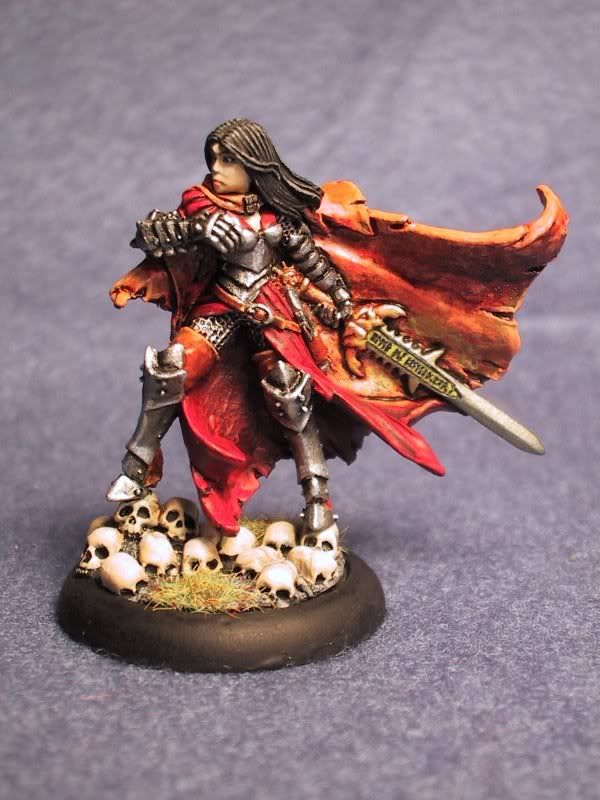 I picked one of the first models I posted and one of the most recent. The difference is pretty striking. I'm honestly quite happy with how my skills have progressed given that this is still just a hobby for me. Painting Alexia way back then was a pretty big challenge. Putting her side-by-side with Rhyas is no contest. My blending is smoother, my metalics are far superior, my brush accuracy is better, and finally I'm sure I spent less time on Rhyas than I did on Alexia.
 Basing is also something I go the extra mile on now. It's not enough to just flock and forget now. Even basic troopers get some sort of hand-made decoration to their bases. Overall I feel like I've struck a good balance of improving my quality while still getting models completed. If anything, that's the one thing that hasn't changed. Unless I'm painting for a competition, I like to keep moving on to strike a good balance between quality and completions.
General Blogging:
When I first started, blogging was pretty awkward. And my pictures were terrible to say the least. I'm certainly no master now, but after this many posts I've become much more comfortable with throwing up random posts. I've also learned how to take better pictures, make better use of Blogger, optimize the whole blog entry process to minimize the impact to hobby time, and generally feel competent about sharing my thoughts.
Final Thoughts:
First, I want to actually thank all the folks out there that posted good comments. Second, I can look back on the last 5 years of blogging for this hobby and really appreciate the investment in it. Third and finally, to all the other hobby bloggers out there, keep at it! The inspiration out there is part of what makes this hobby stay fresh for so long. Here's to 5 more years of painting like we have a pair!
Stats:
What would a review be without some good old fashioned stats!
Total models painted: 323 (that's almost 1 model per week)
Total posts: 524 (that's about twice a week)
Published comments: 304
Current average hits per day: about 70 (Thank you IABN!)
Painting Skill:
I picked one of the first models I posted and one of the most recent. The difference is pretty striking. I'm honestly quite happy with how my skills have progressed given that this is still just a hobby for me. Painting Alexia way back then was a pretty big challenge. Putting her side-by-side with Rhyas is no contest. My blending is smoother, my metalics are far superior, my brush accuracy is better, and finally I'm sure I spent less time on Rhyas than I did on Alexia. Basing is also something I go the extra mile on now. It's not enough to just flock and forget now. Even basic troopers get some sort of hand-made decoration to their bases. Overall I feel like I've struck a good balance of improving my quality while still getting models completed. If anything, that's the one thing that hasn't changed. Unless I'm painting for a competition, I like to keep moving on to strike a good balance between quality and completions.
General Blogging:
When I first started, blogging was pretty awkward. And my pictures were terrible to say the least. I'm certainly no master now, but after this many posts I've become much more comfortable with throwing up random posts. I've also learned how to take better pictures, make better use of Blogger, optimize the whole blog entry process to minimize the impact to hobby time, and generally feel competent about sharing my thoughts.
Final Thoughts:
First, I want to actually thank all the folks out there that posted good comments. Second, I can look back on the last 5 years of blogging for this hobby and really appreciate the investment in it. Third and finally, to all the other hobby bloggers out there, keep at it! The inspiration out there is part of what makes this hobby stay fresh for so long. Here's to 5 more years of painting like we have a pair!
Sunday, November 20, 2011
Bethayne, Voice of Everblight
 This wraps up my current unpainted Legion models, and (until eVayl comes out) a complete set of all the warlocks and beasts. The pictures here are a little dull for some reason, despite shooting them multiple times. The metal for her blades is highly washed out. I really need an overhead light.
This model was pretty fast and easy to paint, with the exception that her right hand is covering her chest and made it a little rough to get in there with the brush. However the rest of it went pretty well. I gave her a much darker skin tone that most of the other warlocks, mainly to give a bit more color contrast with the rest of the surfaces. The blue/black leathers and metals needed some contrast so the darker skin tone pushes more into the purple to help achieve that.
This wraps up my current unpainted Legion models, and (until eVayl comes out) a complete set of all the warlocks and beasts. The pictures here are a little dull for some reason, despite shooting them multiple times. The metal for her blades is highly washed out. I really need an overhead light.
This model was pretty fast and easy to paint, with the exception that her right hand is covering her chest and made it a little rough to get in there with the brush. However the rest of it went pretty well. I gave her a much darker skin tone that most of the other warlocks, mainly to give a bit more color contrast with the rest of the surfaces. The blue/black leathers and metals needed some contrast so the darker skin tone pushes more into the purple to help achieve that.
 Painting both Bethayne and Belphagore at the same time turned out to make things much easier. They had a lot of common surfaces to paint, but each one had more of one type of surface than the other in general. For example, Bethayne's flesh is much more obvious than Belphagore's, whereas Belphagore's armor is clearly more prominent than Bethayne's. So painting process wise it worked out well because I could mix paint and concentrate more on one than the other as I worked each section.
Well, that's it for today. My desk is remarkably barren at this time so I need to get to work assembling something to paint next, provided I don't get distracted further by reading Domination.
Painting both Bethayne and Belphagore at the same time turned out to make things much easier. They had a lot of common surfaces to paint, but each one had more of one type of surface than the other in general. For example, Bethayne's flesh is much more obvious than Belphagore's, whereas Belphagore's armor is clearly more prominent than Bethayne's. So painting process wise it worked out well because I could mix paint and concentrate more on one than the other as I worked each section.
Well, that's it for today. My desk is remarkably barren at this time so I need to get to work assembling something to paint next, provided I don't get distracted further by reading Domination.
Belphagore
 This will just be a really quick post since I'm going to post Bethayne right away as well. Technically they aren't really "done" since I haven't sealed them yet. But since they are completed and I'm just waiting for my shipment of sealer come in I figured I'd go ahead and post them. After my recent experience with the Krylon satin sealer, I've decided to go back to my tried and true Testors double coating. Anyway, another post coming right up!


Wednesday, November 16, 2011
From the Desk: Paired Painting
 Quick desk update here. I'm painting Bethayne and Belphagore together so that they match in color scheme as much as possible. The colors used are identical, but the patterning and shading has some variances in how it was applied. Overall though they are pretty consistent so far.
I'm not entirely sure why these pictures turned out so blue-ish, but it gives a general idea of the progress. I tried to do a little color correction, but honestly I think my background caused most of the problem and it turned the whole "touch-up" exercise into a level of effort far beyond a "from the desk" type of post.
Quick desk update here. I'm painting Bethayne and Belphagore together so that they match in color scheme as much as possible. The colors used are identical, but the patterning and shading has some variances in how it was applied. Overall though they are pretty consistent so far.
I'm not entirely sure why these pictures turned out so blue-ish, but it gives a general idea of the progress. I tried to do a little color correction, but honestly I think my background caused most of the problem and it turned the whole "touch-up" exercise into a level of effort far beyond a "from the desk" type of post.
 This pair represents the last of my unpainted Legion at this point, although I am anxiously awaiting the release of eVayl at the end of the month. I was hoping to have these done before the end of the week since our Foodmachine tournament is this Saturday, but with the Domination book release today I may not get much painting done for the next couple days.
Friday, November 11, 2011
Hex Hunters and Bayal, Hound of Everblight
 Hex Hunters finally done! No fancy post today. I'm totally sick with the flu. Perhaps I'll muster enough energy to paint a bit, but not enough to go into normal detail about these guys.
These were actually nice sculpts to paint. I think in hindsight I should have painted Bayal separately and spent a bit more time on him so that he really stood out better.
Hex Hunters finally done! No fancy post today. I'm totally sick with the flu. Perhaps I'll muster enough energy to paint a bit, but not enough to go into normal detail about these guys.
These were actually nice sculpts to paint. I think in hindsight I should have painted Bayal separately and spent a bit more time on him so that he really stood out better.


Subscribe to:
Posts (Atom)